Article
Why every value is per 100 g and how to scale it
On this site, as on every Swiss label, each figure refers to 100 g. That is no accident: only a fixed quantity makes two foods comparable. What remains is the second step: turning those theoretical 100 g into the plate actually in front of you.
100 g: a comparison basis, not a portion
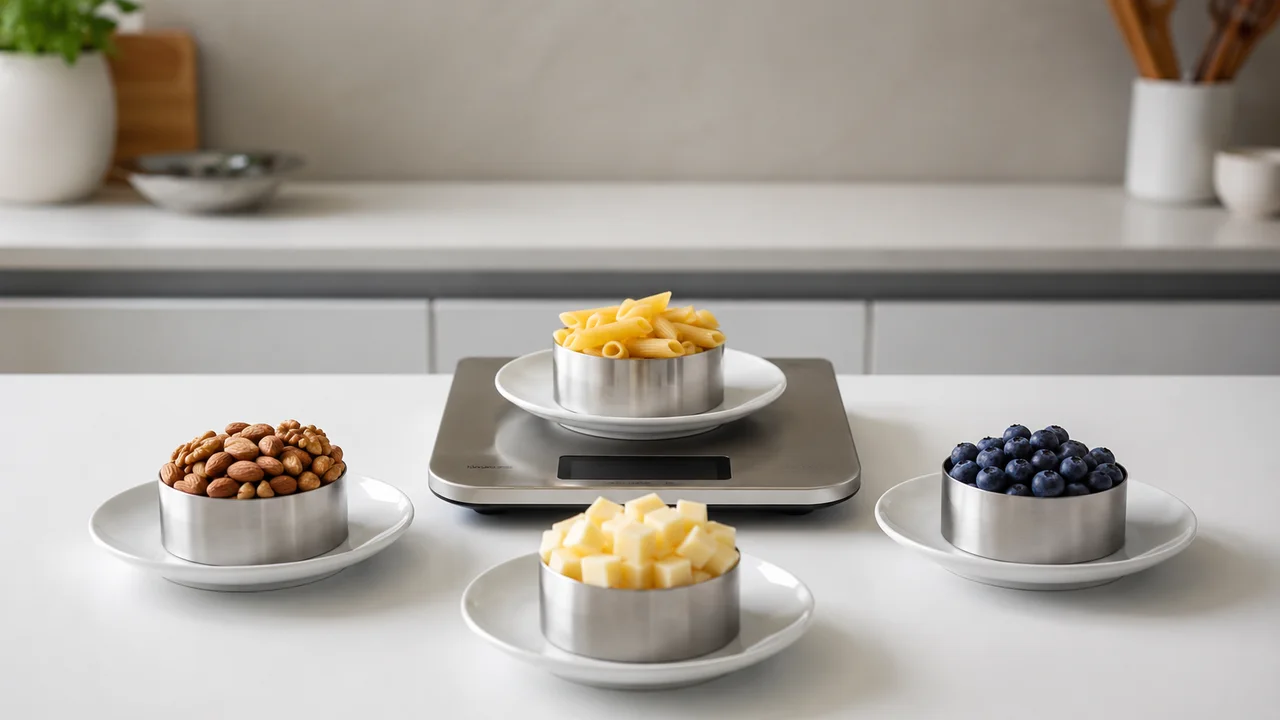
The official Swiss nutrient database describes 1,216 generic foods across 19 families, with up to 22 recorded components per entry. Every figure refers to the same quantity: 100 grams. The reason is practical. A “portion” has no single definition: it shifts with the food, the habit, the brand, the appetite of the day. 100 g, by contrast, is the same for everyone.
Swiss labels follow the same convention, which is what lets you set a branded product beside a generic entry from the FSVO database. The rule applies everywhere on this site: the food comparison tool works out its gaps per 100 g, and the full list of foods shows composition on that same basis. Two figures can only be compared when the same quantity sits behind them.
Dry weight, cooked weight: two separate entries
The same food can appear twice in the database, in two states, and the figures then have little in common. Polished rice, raw, holds 352 kcal, 7.4 g of protein and 12.3 g of water per 100 g. Rice cooked in salted water drops to 117 kcal and 2.5 g of protein, with 71.2 g of water. Nothing vanished: the grain took up water, so 100 g of cooked rice contains less rice.
Same gap for the whole dried lentil: 313 kcal, 24.4 g of protein and 23.2 g of fibre per 100 g, against 111 kcal, 8.8 g and 8.5 g once cooked without fat. Cooking does not always dilute, though: raw spinach shows 25 kcal and 94.4 µg of folate, steamed spinach 31 kcal and 74.5 µg. So always read the state given in the entry name before comparing.
From 100 g to your portion: a single multiplication
The conversion is one operation. Divide your portion weight by 100, then multiply each value by that factor. For 150 g the factor is 1.5; for 30 g, 0.3; for 250 g, 2.5. Nothing else is needed: database contents are proportional to weight.
A few examples, all worked out from the official per-100 g values:
| Food | Per 100 g | Portion | Energy of the portion |
|---|---|---|---|
| Rice polished, cooked in salted water | 117 kcal | 150 g | 176 kcal |
| Lentil, whole, dried | 313 kcal | 60 g | 188 kcal |
| Apple, fresh | 52 kcal | 150 g | 78 kcal |
| Olive oil | 900 kcal | 10 g | 90 kcal |
The same multiplication applies to protein, fibre, minerals and vitamins. 150 g of cooked lentils carries 8.5 × 1.5 = 12.8 g of fibre, a figure to place against the ranking of foods by fibre content, which is also built per 100 g.
The percentages scale too
Next to every content figure, this site shows a share of the nutrient reference values for an adult: 2,000 kcal of energy, 50 g of protein, 30 g of fibre, 800 mg of calcium, 375 mg of magnesium, 14 mg of iron. These labelling benchmarks act as a scale, not as a personal target. For fibre, the 30 g is an indicative value, outside annex 10.
The arithmetic follows the portion. For 150 g of cooked rice: 117 × 1.5 = 176 kcal, or 8.8 % of the energy reference. For 150 g of cooked lentils: 12.8 g of fibre, 43 % of the 30 g reference, and 13.2 g of protein, 26 %. A 150 g fresh apple gives 78 kcal, about 3.9 %. To relate those figures to your own profile, the needs calculator estimates a daily energy expenditure.
The portion selector, and what it does not tell you
On every food page, three buttons (30 g, 100 g, 150 g) plus a free gram field run that multiplication live: the composition table and the percentages recalculate, the portion label changes, the source stays the same. A value missing from the database, marked “n/a”, stays “n/a” at any portion: a gap is never filled with an estimate.
Three limits are worth stating. First, the database gives the composition of a food, not the weight of your plate: weighing or estimating is up to you. Second, it does not say how much 60 g of dried lentils weighs once cooked, because the yield depends on the cooking. Third, a portion shown on screen is neither a recommendation nor advice: it is a calculation applied to the weight you chose.