Article
Rice vs pasta calories per 100 g: cooked and uncooked, from official data
Weighed dry, white rice and egg pasta are almost tied on calories; boiled, each 100 g carries around a third of that energy, and the ranking can flip with the records chosen. The difference is water absorbed during cooking. Here are the four official Swiss FSVO records, read on an equal footing: uncooked against uncooked, cooked against cooked.
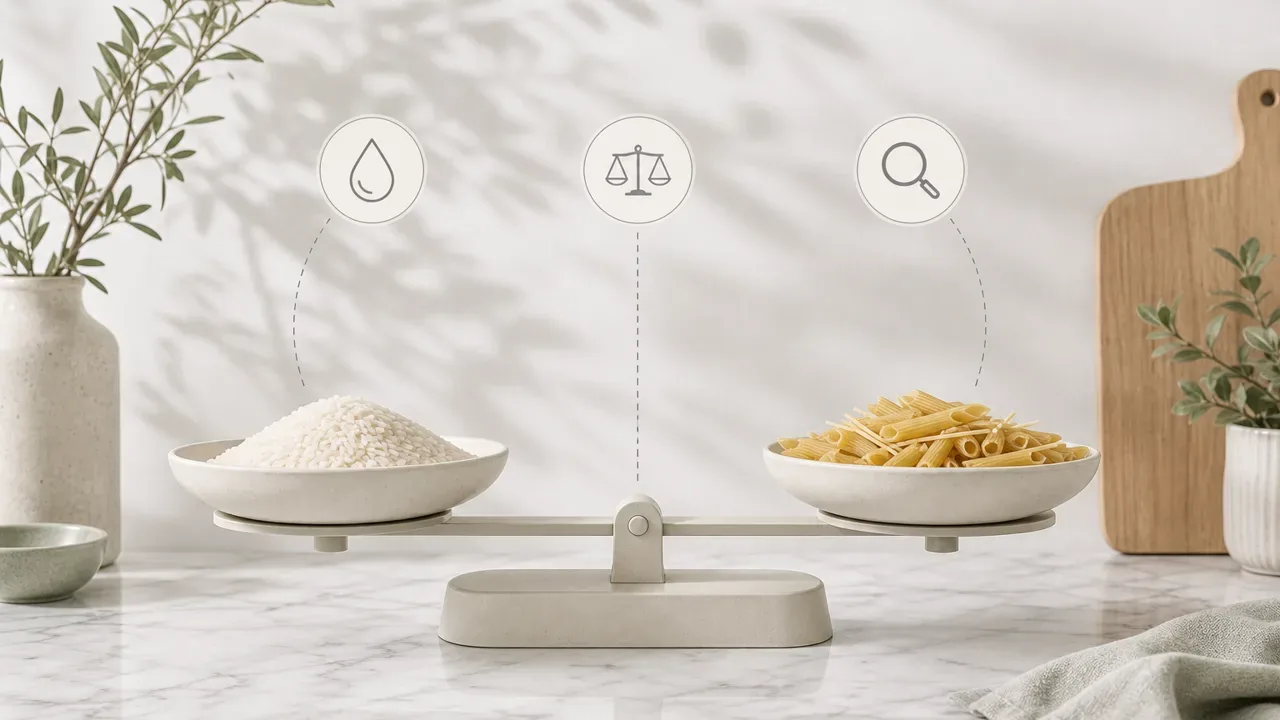
Uncooked, a near tie on calories
Per 100 g, the uncooked polished rice record in the Swiss food composition database (FSVO) lists 352 kcal, 78 g of carbohydrates, 7.4 g of protein and only 12.3 g of water. The dry egg pasta record shows 365 kcal, 69.9 g of carbohydrates, 13.3 g of protein and 10.7 g of water.
Each dry product covers around 18% of the 2000 kcal reference per 100 g. The clearest gap is not energy but protein: at 13.3 g, egg pasta reaches 27% of the 50 g reference, egg and durum wheat semolina both contributing.
Cooked, the same 100 g carries far fewer calories
After boiling, the picture changes. Cooked polished rice comes to 117 kcal per 100 g, with 25.8 g of carbohydrates, 2.5 g of protein and 71.2 g of water. Cooked egg pasta lists 132 kcal, with 25 g of carbohydrates, 5 g of protein and 67.7 g of water.
The rice did not lose calories in the pot: water was added, climbing from 12.3 g to 71.2 g in the rice and from 10.7 g to 67.7 g in the pasta. Each 100 g on the plate holds less grain; in cooked rice, water weighs 2.8 times the carbohydrates, and a 100 g cooked portion covers only 6% (rice) or 7% (pasta) of the 2000 kcal reference.
Calorie counting: dry weight or cooked weight
Calorie tracking hinges on one question: which weight belongs in the log. The FSVO publishes a record for each state, and the pairing is mechanical: dry weight with the dry record, 352 kcal per 100 g for rice; plate weight with the cooked record, 117 kcal. An entry that crosses the two is off by a factor of about three.
In portions: 200 g of cooked rice comes to 234 kcal and 200 g of cooked egg pasta to 264 kcal, while 80 g of dry pasta already lists 292 kcal. Per 100 g, cooking divides the energy value by roughly three for rice (352 versus 117 kcal) and slightly less for pasta (365 versus 132 kcal).
Why calorie tables contradict each other online
Most pages pitting rice against pasta mix the two states without saying so: a dry value sits next to a cooked one. Setting 352 kcal of dry rice against 132 kcal of cooked pasta compares two states, not two foods, and hands the win to whichever food is listed cooked.
With the state fixed, the contradiction disappears: egg pasta sits slightly above rice whether both are dry or both are boiled. A ranking that flips from one site to the next is an artefact of mismatched records.
Wholemeal pasta: the fibre line
The FSVO database also lists dry wholemeal pasta: 338 kcal per 100 g, close to the white versions, but 11.5 g of dietary fibre. That line, far more than energy, separates wholegrain products from refined ones; the ranking of foods by fibre content shows it across the entire database.
The cooked-versus-uncooked logic applies unchanged: absorbed water dilutes fibre as it dilutes energy, protein and carbohydrates. The content per 100 g goes down, but the amount on the plate remains that of the dry product weighed before cooking.
The method: same source, same state, same quantity
The method rests on three points. One source: the four records come from the Swiss food composition database published by the FSVO, 1216 foods across 19 categories, 22 nutrients per record. One state: dry against dry, cooked against cooked. One quantity: values per 100 g scale to the portion weighed with the portion calculator.
To set two records side by side, nutrient by nutrient and in the same state, the food comparison tool applies exactly this method to any pair from the catalogue.