Various
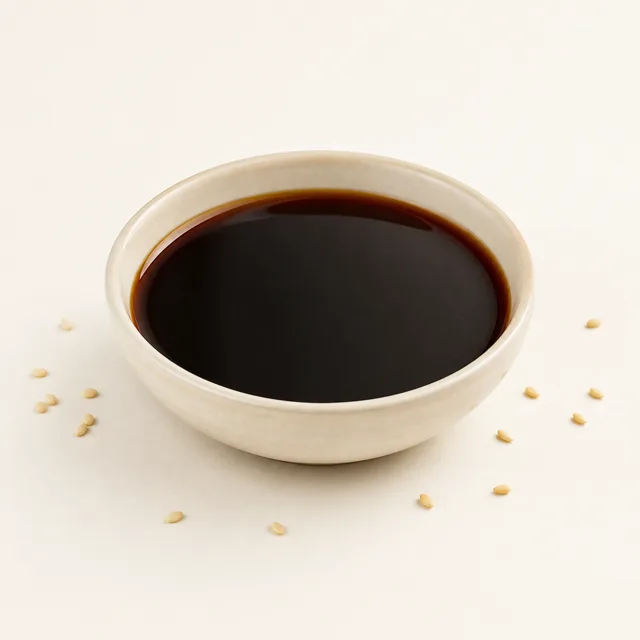
Soy sauce
Sauces
56 kcal / 100 g
FSVO V7.1
100 g of Soy sauce provides 56 kcal (236 kJ). Energy density and nutrient contents are detailed below, value by value. This food belongs to the “Sauces” category (“Various” family) of the Swiss database.
The essentials for 100 g
Protein8.1 g
16%
Fat0.6 g
1%
Carbohydrates4.1 g
2%
Dietary fibre0.8 g
3%
% of nutrient reference values (adults), for the displayed portion.
Detailed composition
for 100 g| Nutrient | Value | % NRV* |
|---|---|---|
| Macronutrients | ||
| Energy | 56 kcal (236 kJ)C | 3% |
| Protein | 8.1 gA | 16% |
| Fat | 0.6 gA | 1% |
| of which saturated fat | 0.1 gA | 1% |
| of which polyunsaturated | 0.3 gA | n/a |
| of which omega-3 | n/a | n/a |
| Carbohydrates | 4.1 gA | 2% |
| of which sugars | 0.4 gA | 0% |
| Dietary fibre | 0.8 gA | 3% |
| Water | 71.2 gA | n/a |
| Alcohol | 0 gA | n/a |
| Minerals | ||
| Calcium | 33 mgA | 4% |
| Iron | 1.5 mgA | 11% |
| Magnesium | 74 mgA | 20% |
| Phosphorus | 170 mgA | 24% |
| Potassium | 440 mgA | 22% |
| Sodium | 5,490 mgA | 229% |
| Zinc | 0.9 mgA | 9% |
| Vitamins | ||
| Vitamin D | 0 µgA | 0% |
| Vitamin B12 | 0 µgA | 0% |
| Vitamin C | 0 mgA | 0% |
| Folate | 14 µgA | 7% |
* Share of the nutrient reference values for adults (Swiss FIC ordinance, annex 10), for the displayed portion. For dietary fibre the annex sets no value: the 30 g a day is an indicative benchmark. “n/a”: value not available in the source, never estimated by us. A, E or C indicates each value’s origin.