Fruit
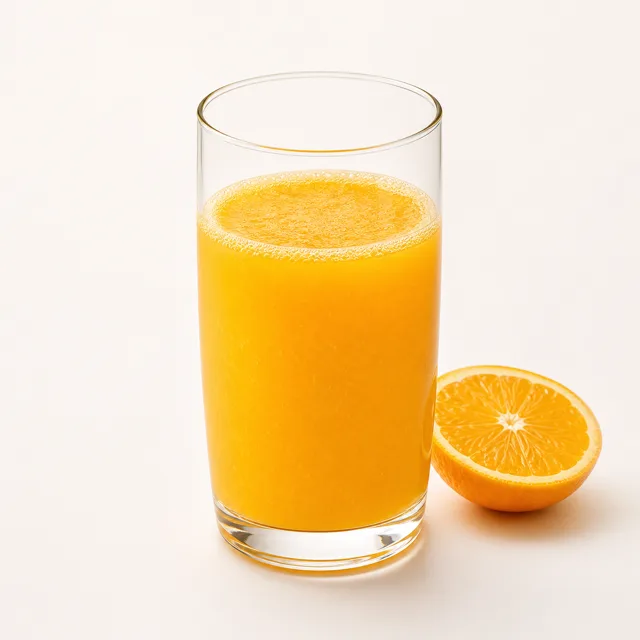
Orange juice
Fruit juices
42 kcal / 100 g
FSVO V7.1
100 g of Orange juice provides 42 kcal (180 kJ). Its composition stands out for its content of vitamin C (37 mg) per 100 g. This food belongs to the “Fruit juices” category (“Fruit” family) of the Swiss database.
The essentials for 100 g
Protein0.6 g
1%
Fat0.1 g
0%
Carbohydrates9.6 g
4%
Dietary fibre0.3 g
1%
% of nutrient reference values (adults), for the displayed portion.
Detailed composition
for 100 g| Nutrient | Value | % NRV* |
|---|---|---|
| Macronutrients | ||
| Energy | 42 kcal (180 kJ)C | 2% |
| Protein | 0.6 gA | 1% |
| Fat | 0.1 gA | 0% |
| of which saturated fat | 0.1 gA | 1% |
| of which polyunsaturated | 0 gA | n/a |
| of which omega-3 | n/a | n/a |
| Carbohydrates | 9.6 gA | 4% |
| of which sugars | 9.6 gA | 11% |
| Dietary fibre | 0.3 gA | 1% |
| Water | 88.2 gA | n/a |
| Alcohol | 0 gE | n/a |
| Minerals | ||
| Calcium | 8 mgA | 1% |
| Iron | 0.1 mgA | 1% |
| Magnesium | 10 mgA | 3% |
| Phosphorus | 17 mgA | 2% |
| Potassium | 170 mgA | 9% |
| Sodium | 5 mgA | 0% |
| Zinc | 0 mgA | 0% |
| Vitamins | ||
| Vitamin D | 0 µgE | 0% |
| Vitamin B12 | 0 µgE | 0% |
| Vitamin C | 37 mgA | 37% |
| Folate | 30 µgA | 15% |
* Share of the nutrient reference values for adults (Swiss FIC ordinance, annex 10), for the displayed portion. For dietary fibre the annex sets no value: the 30 g a day is an indicative benchmark. “n/a”: value not available in the source, never estimated by us. A, E or C indicates each value’s origin.