Skip to content

Cereal products, pulses and potatoes

Couscous (precooked durum wheat semolina), cooked (without addition of fat and salt)

Other cereal products 158 kcal / 100 g FSVO V7.1

100 g of Couscous (precooked durum wheat semolina), cooked (without addition of fat and salt) provides 158 kcal (667 kJ). Energy density and nutrient contents are detailed below, value by value. This food belongs to the “Other cereal products” category (“Cereal products, pulses and potatoes” family) of the Swiss database.
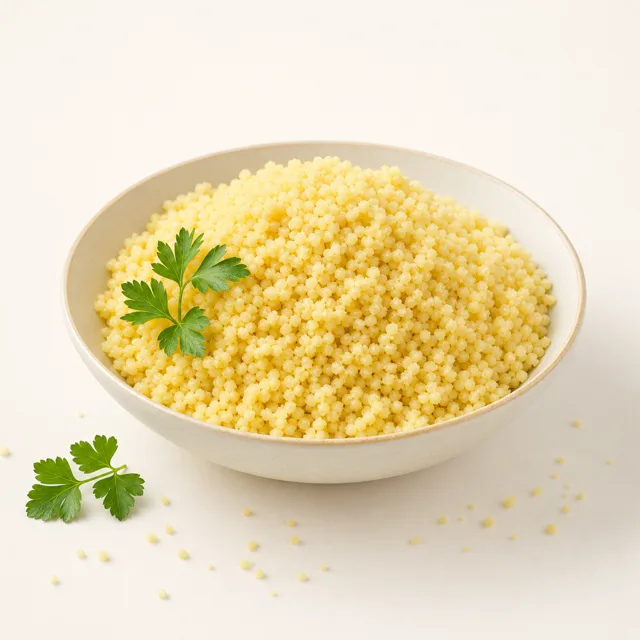
Couscous (precooked durum wheat semolina), cooked (without addition of fat and salt)

The essentials for 100 g

Protein5 g 10%
Fat1 g 1%
Carbohydrates31 g 12%
Dietary fibre2.3 g 8%

% of nutrient reference values (adults), for the displayed portion.

Detailed composition

for 100 g
NutrientValue% NRV*
Macronutrients
Energy158 kcal (667 kJ)C8%
Protein5 gE10%
Fat1 gE1%
of which saturated fat0.3 gE2%
of which polyunsaturated0.4 gEn/a
of which omega-30 gCn/a
Carbohydrates31 gE12%
of which sugars1.6 gE2%
Dietary fibre2.3 gE8%
Water60.6 gEn/a
Alcohol0 gEn/a
Minerals
Calcium15 mgE2%
Iron0.5 mgE4%
Magnesium19 mgE5%
Phosphorus73 mgE10%
Potassium110 mgE6%
Sodium< 5 mgAn/a
Zinc0.6 mgE6%
Vitamins
Vitamin D0 µgE0%
Vitamin B120 µgE0%
Vitamin C< 0,5 mgAn/a
Folate12 µgE6%

* Share of the nutrient reference values for adults (Swiss FIC ordinance, annex 10), for the displayed portion. For dietary fibre the annex sets no value: the 30 g a day is an indicative benchmark. “n/a”: value not available in the source, never estimated by us. A, E or C indicates each value’s origin.
As a share of daily needs

Covered by 100 g · reference population: average adult.

Protein10%
Fat1%
Carbohydrates12%
Dietary fibre8%
Phosphorus10%
Folate6%
Zinc6%
Potassium6%
Magnesium5%

Quick comparison

Difference per 100 g from this food’s point of view: “+” = it contains more than the compared food.

ComparisonProteinFatEnergy
vs Spätzli, cooked, drained, homemade− 1.7 g− 1.3 g+ 12 kcal
vs Pearl barley, cooked in salted water (uniodised)+ 1.4 g+ 0.2 g+ 24 kcal
vs Millet risotto, cooked+ 1.2 g− 2.2 g+ 12 kcal
vs Spätzli, fried (without added fat and salt)− 2.7 g− 1.6 g− 10 kcal
vs Spätzli, fried with butter− 2.3 g− 5.9 g− 41 kcal

Frequently asked questions

How many calories in 100 g of Couscous (precooked durum wheat semolina), cooked (without addition of fat and salt)?
100 g of Couscous (precooked durum wheat semolina), cooked (without addition of fat and salt) provides 158 kcal, i.e. 667 kJ (FSVO data V7.1).
How much protein in 100 g of Couscous (precooked durum wheat semolina), cooked (without addition of fat and salt)?
100 g provides 5 g of protein, i.e. 10% of the adult reference value (50 g).
What is the fat content of 100 g of Couscous (precooked durum wheat semolina), cooked (without addition of fat and salt)?
100 g contains 1 g of fat, of which 0.3 g saturated fatty acids.
Where do these values come from?
From the Swiss food composition database V7.1 published by the FSVO (July 2026). Every value carries an origin indicator: A (measured), E (estimated) or C (calculated).
Which preparation state do the values refer to?
To the official label “Couscous (precooked durum wheat semolina), cooked (without addition of fat and salt)” in the database: the state (raw, cooked, drained…) is specified where relevant. Preparation substantially changes the composition per 100 g, especially the water content.

What about your needs?

Estimate your daily energy needs, then see how each portion compares. Local computation, no sign-up.

Calculate my needs